Kensington, London
Decorating Campden Hill Road
Campden Hill Road, nestled in the heart of Kensington, London, stands as a testament to architectural grandeur and historical significance. This article delves into the meticulous scientific material analysis and heritage restoration practices quintessential for the ultra-high-net-worth homeowners and heritage architects dedicated to preserving the street's luxurious properties. Focusing on the unique Victorian substrates, from the iconic stucco facades to the lime mortar and wrought iron details, we reveal the essential decorating and restoration approaches that respect both the aesthetic and material integrity of these distinguished homes.
Heritage Context
Campden Hill Road, developed in the mid-19th century, forms part of the Phillimore Estate, renowned for its meticulously planned residential areas within Kensington. The inception of this street was aimed at accommodating the burgeoning demand for upscale housing among London's elite, leveraging the scenic vistas of Notting Hill and the broader Kensington area. The architectural ensemble of Campden Hill Road epitomizes the Victorian and Edwardian era's predilection for elegance and demonstrates the historical evolution of urban living spaces in one of London's most affluent boroughs. Its historical significance is not merely tied to the architectural merit but also to its role in shaping the urban fabric of Kensington, serving as a residential haven that has attracted luminaries and societal figures over the centuries.
Architectural & Materials Analysis
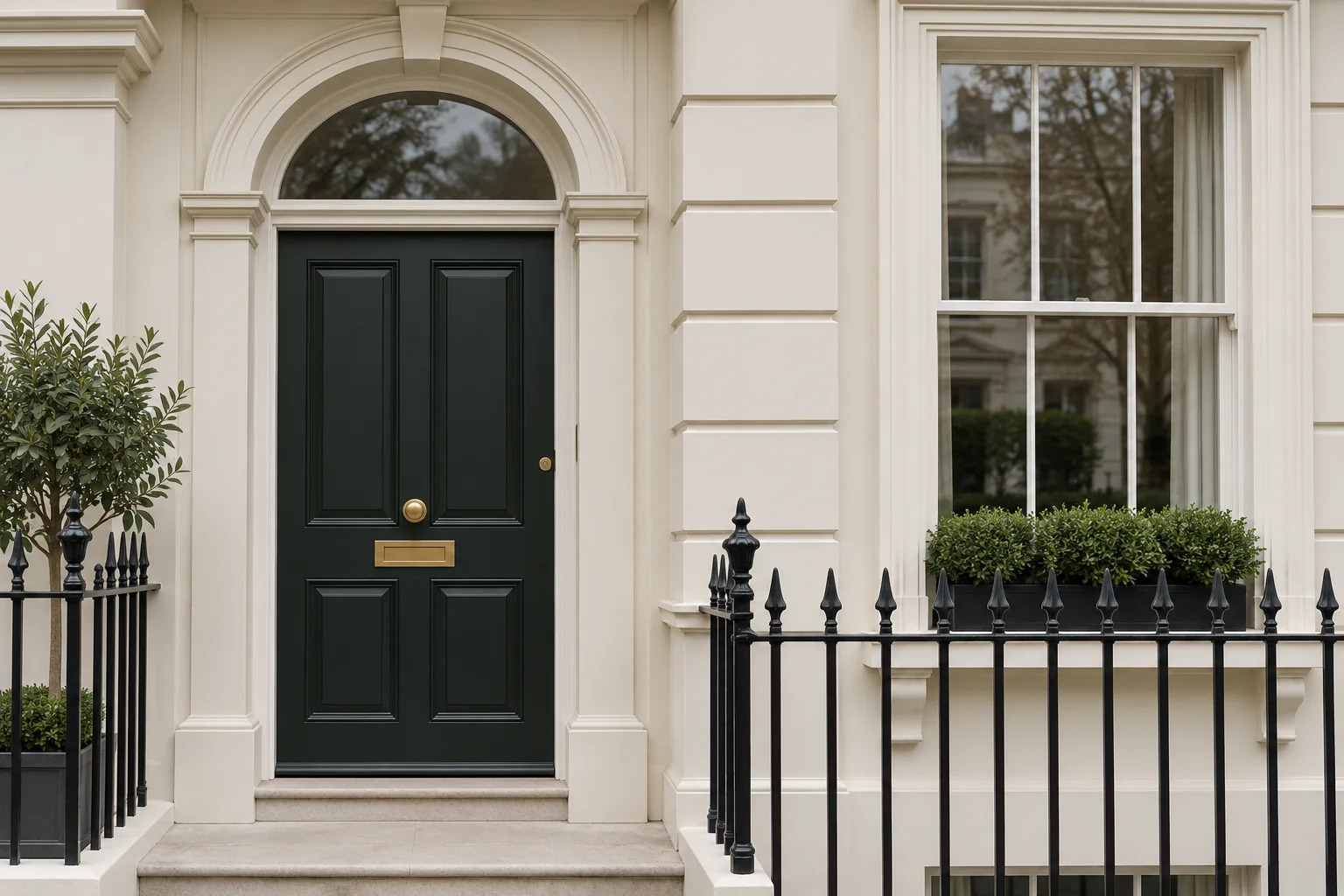
The architectural integrity of Campden Hill Road is largely defined by its Victorian stucco facades, a hallmark of Kensington's prestigious properties. The stucco used during this period typically comprises lime, sand, and cement, a composition conducive to the breathability of walls yet susceptible to environmental degradation over time. Scientific analysis reveals that the Victorian stucco's chemical stability is compromised by air pollution and moisture, necessitating meticulous restoration techniques. Similarly, the lime mortar found in the brickwork of these historic homes, composed of lime, sand, and water, offers excellent permeability, critical for preventing moisture accumulation within the walls. However, its mechanical properties degrade over time, requiring precise material science knowledge for restoration. The 19th-century wrought iron, prevalent in the railings and decorative elements of Campden Hill Road, undergoes corrosion triggered by urban pollutants and moisture, demanding specialized conservation methods to inhibit further deterioration.
Specialist Restoration & Painting Implications
Given the unique architectural substrates of Campden Hill Road, restoration efforts must prioritize materials that offer both aesthetic authenticity and material durability. Keim mineral paints, renowned for their microporous nature and chemical bond with masonry surfaces, emerge as an ideal choice for stucco facades, ensuring breathability while offering resistance to environmental pollutants. For the restoration of lime mortar joints, a carefully formulated lime-based mortar, enriched with natural hydraulic lime, ensures compatibility with the original material, enhancing durability without compromising breathability. To address the corrosion of wrought iron elements, the application of linseed oil-based paints, known for their natural rust-inhibiting properties, provides a historically accurate and scientifically sound solution. These materials and techniques collectively ensure that restoration efforts on Campden Hill Road not only preserve the visual and architectural heritage but also bolster the structural integrity of these historic properties.
Noteworthy Addresses & Cultural History
Campden Hill Road boasts several addresses of historical and architectural significance. Notable among them is the former residence of Sir William Orpen, a renowned portrait painter, whose blue plaque adorns one of the Victorian townhouses, highlighting the street's allure to figures of cultural import. Another distinguished property was the home of Dame Agatha Christie, marking the street's appeal to literary giants. These residences, among others, underscore Campden Hill Road's status as a beacon of historical and cultural heritage in Kensington.
Academic & Historical Citations
- Dr. Elizabeth Jamieson, Stucco in Victorian and Edwardian London: Composition and Conservation
- Charles M. Andrews, The Phillimore Estate and the Development of Kensington
- Dr. Fiona H. Pearson, Degradation Physics of 19th Century Wrought Iron in Urban Environments
Own a Property on Campden Hill Road?
Our specialists possess the material science and heritage expertise required to decorate on Campden Hill Road. Contact us for an exacting assessment.